Choose The Right Route Out
An intact lift is worth assessing where the tank can be disconnected, cleaned and reached safely. It avoids dismantling the vessel on site, but the lifting position, ground conditions and transport route must all suit the load.
Sectional removal may suit a basement or building where the tank no longer fits through the doors. Cold cutting can be considered after preparation and atmosphere checks. It is not permission to cut an apparently empty tank without controls.
For a buried tank, excavation introduces further questions about services, nearby foundations, groundwater and reinstatement. If physical removal is impracticable, compare it with assessed closure in place before committing to the end state.
Resolve The Remaining Fuel First
An old contents gauge is only a starting estimate. The assessment needs the product history, approximate recoverable volume and signs of water or sludge, because those contents affect tanker capacity and the work sequence.
Usable fuel may be recoverable into suitable temporary storage or another compatible tank, subject to condition and an agreed destination. Poor-quality fuel and residues need a separate waste route. Do not mix usable stock with oily water simply to empty the tank faster.
Tell us whether the tank still supplies heating, a generator or a process. Its final shutdown must be coordinated with the person responsible for that equipment, including any replacement supply and the point at which disconnection is authorised.
Prepare Before Cutting Or Lifting
The agreed method should cover isolations, fuel uplift, removal of deposits, cleaning and atmospheric assessment. Preparation is a separate stage from the lift or dismantling itself, and must be completed to the standard needed for the proposed work.
A tank that looks empty can retain dangerous residues. HSE’s tank storage guidance addresses isolation and preparation for maintenance. If hot work is proposed, the method needs specific fire and vapour controls rather than an assumption that draining was enough.
The scope should identify redundant supply lines, vents, fill cabinets and supports. Agree which are included, where retained services will terminate and whether the base or bund is to remain.
Make The Yard Or Building Accessible
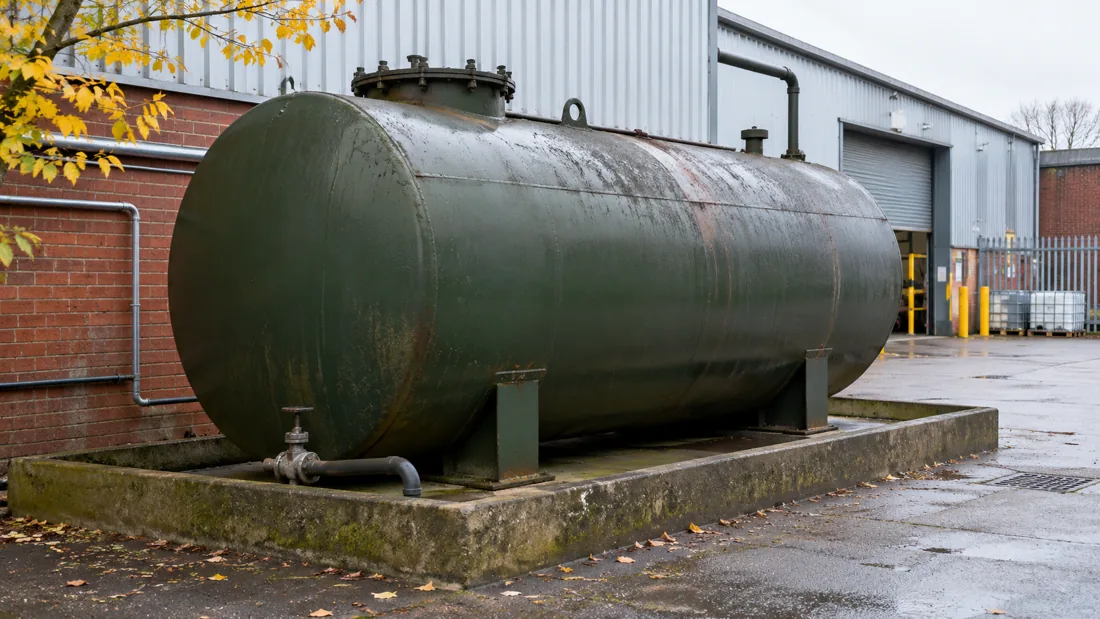
Photograph the entire removal route, including the tank enclosure, narrow gateways, turns, overhead obstructions and the proposed vehicle position. Tank dimensions and door dimensions are both useful. A close-up of the tank alone cannot establish the route.
In a logistics yard, a lifting exclusion zone may affect loading bays, pedestrian routes and neighbouring tenants. Identify the person who can reserve the space and the hours when deliveries can be diverted. Ground bearing and underground services need consideration before lifting equipment is positioned.
Inside a building, stairs, thresholds, fragile floors and ventilation can affect sectional handling. Do not remove walls, widen openings or move the tank yourself to make the survey easier. Record the restrictions and let the removal method account for them.
Understand The Cost Drivers
Capacity influences fuel handling and cleaning, but size does not determine the whole cost. A relatively small tank behind a restricted opening can require more labour and equipment than a larger accessible vessel.
The quotation should distinguish preparation, fuel transfer, waste treatment, cutting or lifting, transport and any making good. Excavation, suspected contamination and structural alterations need explicit allowances or separate assessment. Ask what happens if the contents or access differ from the information supplied.
Programme length follows the approved method and operational window. Avoid booking follow-on contractors on the assumption that the tank will disappear in a single visit, especially where clearance depends on opening up or confirming its condition.
Keep A Useful Removal Record
Agree the handover list before the work is ordered. It may include the removal scope, photographs, disposal confirmation, and the waste transfer or hazardous waste consignment documents appropriate to each classified stream.
A lifting plan belongs to the lifting work, and relevant testing or gas-free records belong to the preparation method. They are not interchangeable certificates. Ask the provider to explain any exclusions and record parts of the former system that remain.
For a sale or redevelopment, keep these records with the property information. Tank removal does not by itself demonstrate that surrounding soil is uncontaminated. Staining, unexplained product loss or an old leak history may justify a separate environmental investigation.
Your Questions
Can A Tank Be Removed From A Basement?
Basement tank removal may be possible by dismantling the prepared tank into manageable sections. The access route, ventilation, floor loading and handling method need assessment before a method is chosen. Send photographs from the tank to the external exit, including stairs and doorways, rather than only the opening nearest the vessel.
Does Removal Include The Bund And Base?
Tank removal includes the bund and base only when that work is in the agreed scope. Some clients retain a sound base for replacement equipment, while others need a cleared footprint. State whether you want pipework, supports, fill points, concrete and final surface reinstatement included so the quotation reflects the intended finish.