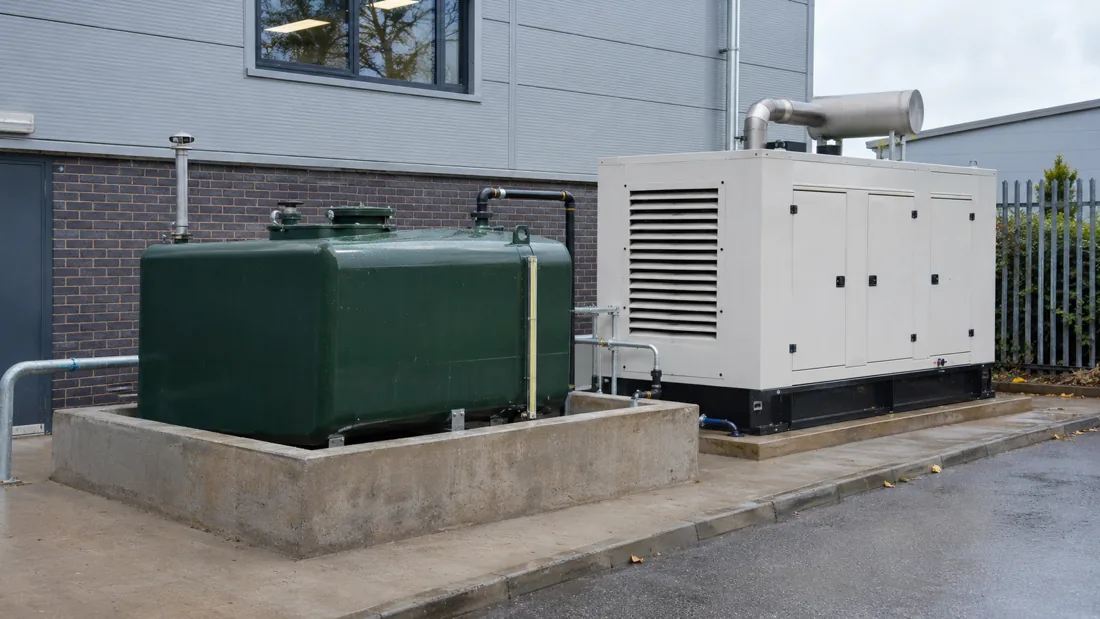
Confirm What The Generator Still Supplies
Before scheduling a removal, identify the person responsible for the building’s electrical system and confirm whether the unit is fully redundant. A set that rarely runs may still support essential equipment or an agreed resilience arrangement.
A replacement project needs a defined changeover point. Explain whether the new supply must be available before the old generator is released, and whether a temporary arrangement has already been specified. The removal plan should work to that decision rather than determine it by default.
Electrical isolation and disconnection belong to competent personnel under the site’s safety arrangements. HSE’s safe working practices guidance supports planning and coordination. This page is not an instruction to disconnect cables, batteries or control circuits yourself.
Identify The Complete Plant Package
Send the manufacturer, model, rating and any available weight information. A photograph of the external data plate is useful if it can be taken safely. Dimensions should include the enclosure or canopy where that is being moved with the unit.
List the connected fuel lines, bulk tank, day tank, exhaust, cooling arrangements and ancillary items. Some sets have a tank within the base. Others draw from a remote storage system that may serve additional equipment, so the boundaries need to be checked.
State whether the destination is reuse, relocation, recycling or disposal. Ownership and the proposed receiving party should be agreed before the equipment is loaded. A unit intended for reuse may need a different handling and preservation specification from scrap plant.
Account For Fuel And Other Liquids
The generator’s engine fuel and the contents of its storage system are separate quantities. Give an estimate for each tank and note when the generator last ran or received a fuel delivery. An unknown base-tank level can affect both handling and liquid recovery.
Usable fuel may be retained where its condition and a suitable destination permit. Contaminated stock needs assessment, and fluids removed from the engine or ancillary equipment must be addressed in the scope. Do not assume that the generator will arrive ready for transport because it has been switched off.
If the bulk tank is also redundant, include tank decommissioning in the enquiry. If fuel will be transferred to replacement equipment, ask whether sampling or fuel polishing is appropriate before that transfer.
Establish The Handling Route
Outdoor equipment may be reachable by a lorry-mounted crane or other lifting arrangement. The assessment still needs the load, reach, ground conditions and obstructions. A lifting point that looks substantial is not evidence that it is approved for the proposed lift.
Plant-room removals require photographs of the full route, including door frames, turns, steps and thresholds. Some generators were installed before the building enclosure was finished. Dismantling, temporary openings or specialist handling may need consideration rather than assuming the original installation route remains usable.
For rooftop or elevated plant, the lifting and building interfaces need closer coordination. Describe roof access, surrounding structures and any known loading limitations. HSE lifting guidance explains planning under the Lifting Operations and Lifting Equipment Regulations 1998 (LOLER). The level of planning must match the complexity of the operation.
Reserve A Workable Site Window
The crane or removal vehicle may occupy space normally used for deliveries or parking. A commercial yard needs a defined exclusion zone, protected pedestrian access and a site contact authorised to keep the route clear during the operation.
Tell us about inductions, permits, security checks, restricted hours and neighbouring occupiers. Access to a port-related or managed estate can require arrangements beyond an ordinary street address. Confirm the actual gate and vehicle destination rather than relying on a postcode alone.
Cost depends on weight, position, disconnection boundaries, liquid recovery, handling equipment and destination. Separate the generator removal from building alterations and final repairs in the quotation. If condition or dimensions are uncertain, expect a survey before a fixed method or programme can be agreed.
Close The Job With Clear Boundaries
The handover should identify what equipment left site, its destination and what remains. A bulk tank, slab, plinth or abandoned cable route should not become an unexpected leftover because the order simply said “remove generator”.
For equipment going as waste, agree the relevant classification and transfer records with the provider. For a genuine reuse transfer, record the receiving arrangement and equipment identity. Waste status cannot be settled just by calling an item second-hand if its actual destination is disposal.
Keep electrical release records from the responsible electrical contractor alongside the removal and fuel-system records. Ask who is responsible for sealing building penetrations, removing exhaust supports and making good the former footprint. Those small interfaces often determine whether the space is ready for its next use.
Your Questions
Can You Remove The Generator And Its Fuel Tank Together?
Generator and fuel tank removal can be considered as a combined scope when the connections and operational release are understood. Send details of both items, including any remote tank and shared supply. The programme needs to coordinate electrical work, fuel recovery, tank preparation and lifting, with responsibilities agreed before the site window is booked.
Do We Need To Know The Generator Weight?
Generator weight information helps establish the handling method, but it should be supported by reliable equipment data and the actual configuration. A canopy, base tank or retained fluids can change the load. Send the model details and available manuals rather than guessing, and flag any modifications that may affect the assessment.